Build Your Own Cheese Ball Launcher: DIY Guide Under $50
Transform a leaf blower into a fun cheese ball firing machine with simple PVC parts and clever airflow tricks.
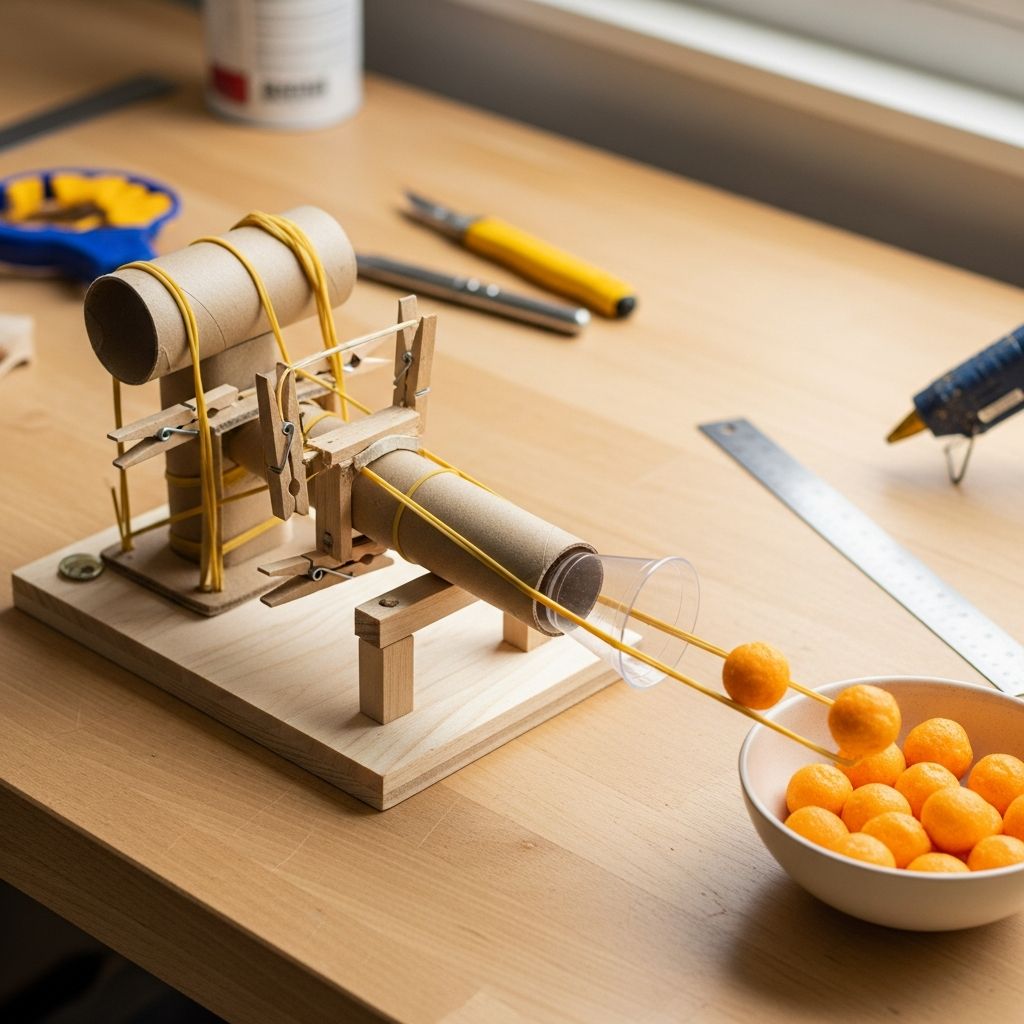
Build Your Own Cheese Ball Launcher
Creating a device that launches cheese balls at high speed using everyday items like a leaf blower and PVC pipes offers a thrilling blend of engineering, physics, and snack-time excitement. This project turns ordinary yard tools into a rapid-fire launcher capable of pelting targets with puffed cheese snacks over impressive distances.
Why Construct a Cheese Ball Launcher?
These launchers captivate makers by demonstrating practical applications of fluid dynamics and pneumatic principles in a playful context. Families enjoy them as interactive toys that encourage outdoor activity and hands-on learning. Unlike static snacks, this setup provides kinetic entertainment, teaching concepts like airflow manipulation while burning through bags of cheese balls in minutes.
The appeal lies in its simplicity: no advanced skills required, just basic plumbing parts and a power tool most households own. Results rival commercial air cannons, delivering bursts up to 50 feet with minimal recoil.
Gathering Essential Materials
To assemble your launcher, collect these readily available components:
- Electric leaf blower (high CFM model preferred for power)
- 1-inch PVC pipe (approximately 3 feet for barrel)
- Two 1-inch PVC T-fittings
- 1-inch PVC coupling and end plug
- Empty cheese ball container (for hopper)
- Epoxy or PVC cement
- Stiff wire (coat hanger or music wire)
- 3/8-inch bolt, nut, and washers
- Wood block or brace for support
- Drill, saw, sandpaper, and utility knife
These items cost under $50 if sourcing from hardware stores, assuming you have a leaf blower. Cheese balls serve as the ‘ammo’—opt for standard puffed varieties that fit 1-inch pipes snugly.
Mastering the Core Physics
The launcher’s effectiveness hinges on Bernoulli’s principle, where fast-moving air creates low-pressure zones to draw projectiles into the stream. High-volume airflow from the leaf blower propels cheese balls through the barrel, but without airflow redirection, pressure buildup blocks feeding. A custom venturi ramp resolves this by generating suction, pulling snacks from the hopper into the high-speed airstream.
This setup achieves muzzle velocities around 40-60 mph, depending on blower strength. Friction in PVC minimizes tumbling, ensuring straight trajectories ideal for target practice.
Step-by-Step Construction Guide
1. Prepare the Barrel Assembly
Cut a 2.5-foot length of 1-inch PVC for the main barrel. Attach a T-fitting to one end, ensuring the side opening faces upward for hopper integration. Connect a short 4-inch PVC section to the T-fitting’s rear—this becomes the venturi chamber. Secure with PVC cement for airtight seals.
2. Fabricate the Venturi Effect
From scrap PVC, carve a thin ramp (1/4-inch thick, angled 45 degrees). Sand to fit snugly inside the short pipe section, positioning it to deflect air away from the T-fitting’s hopper opening. Glue in place; this creates the vacuum essential for reliable feeding. Test airflow direction with smoke or tissue paper before full assembly.
3. Build and Mount the Hopper
Drill a 1-inch hole in the side of an empty cheese ball tub near the base. Insert the T-fitting’s top nipple through, securing internally with a PVC coupling sleeve. Add vent holes in the lid to prevent backpressure. Brace the hopper with a wood block epoxied or taped to the barrel for stability.
4. Integrate with Leaf Blower
Epoxy a 1-inch PVC end cap or adapter into the leaf blower’s output nozzle, matching the venturi pipe’s diameter. Slide the assembly onto this fitting, using the end plug on the barrel’s front for safety. Ensure all joints are sealed to maximize pressure.
5. Add Performance Enhancers
For smoother operation, install an agitator: Drill through a bolt’s center, thread stiff wire through, and mount via nut/washer on the hopper’s rear. Bend the wire into a stirrer inside and a handle outside to jostle stuck balls during firing.
Safety Protocols and Best Practices
While fun, prioritize caution:
- Wear eye protection—cheese balls fragment on impact.
- Operate in open areas away from people, pets, or windows.
- Supervise children; device mimics toy guns but uses real force.
- Check for blockages before powering on.
- Avoid wet conditions to prevent slips or electrical hazards.
Local laws may classify it as a pneumatic launcher; use responsibly on private property.
Performance Tuning Table
| Upgrade | Effect | Difficulty |
|---|---|---|
| Stronger leaf blower (500+ CFM) | +30% range/speed | Easy |
| Smooth interior sanding | Reduces jams by 50% | Easy |
| Extended barrel (4 ft) | Improved accuracy | Medium |
| Agitator wire | Eliminates feed issues | Easy |
| Weighted hopper brace | Stability at full auto | Medium |
Advanced Modifications
Experiment with a compressor instead of a blower for pulsed shots via solenoid valve, mimicking semi-auto fire. 3D-print custom hoppers for larger capacities or integrate LED sights. For precision, add rifling grooves inside the barrel using a router—though cheese balls’ lightness limits spin benefits.
Scale up with 2-inch pipes for bigger projectiles like marshmallows, adjusting venturi proportionally. Battery-powered mini blowers enable portable versions.
Troubleshooting Common Issues
- No firing: Verify seals and venturi orientation.
- Frequent jams: Stir hopper; ensure ball size matches pipe.
- Weak range: Upgrade blower or reduce barrel friction.
- Hopper overflow: Enlarge lid vents.
Fun Applications and Games
Beyond target pelting, host competitions: distance challenges, accuracy drills on moving targets, or defensive snack wars. Pair with edible barriers for culinary battles. Educational demos illustrate pneumatics in classrooms.
Frequently Asked Questions (FAQs)
What is the maximum range of this launcher?
Ranges reach 40-60 feet with optimal setup, varying by blower power and ball quality.
Can I use other snacks?
Yes, marshmallows or popcorn work, but cheese balls offer best size-to-weight ratio.
Is it safe for kids?
Under adult supervision with protective gear, yes—impacts sting but rarely injure.
How long does it take to build?
1-2 hours for basic version, plus drying time for adhesives.
Does it require power tools?
Only a drill and saw; hand tools suffice for most steps.
Environmental and Storage Tips
Store disassembled in dry areas to prevent PVC warping. Reuse containers to minimize waste. Dispose of uneaten balls promptly to avoid pests.
References
- Cheese Ball Machine Gun Instructions — Instructables. 2016-05-20. https://www.instructables.com/Cheese-Ball-Machine-Gun/
- How To Make A Cheese Ball Machine Gun — NightHawkInLight (YouTube Transcript). 2016-05-01. https://www.youtube.com/watch?v=uXcKEu72RCk
- Easy Air Powered Cheese Ball Shooter — YouTube Engineering Demo. 2018-03-15. https://www.youtube.com/watch?v=Rf3VVOZsqqc
- Principles of Pneumatic Launchers — MIT OpenCourseWare (Fluid Dynamics Notes). 2023-09-01. https://ocw.mit.edu/courses/2-23-fluid-dynamics-spring-2013/
- DIY Pneumatic Cannons Safety Guidelines — American Society of Mechanical Engineers (ASME). 2024-02-10. https://www.asme.org/topics-resources/content/pneumatic-safety
Similar Articles








Read full bio of medha deb