Hyperbolic Stretching: Hype, Science, and Safer Alternatives
A critical, science-based look at hyperbolic stretching promises, risks, and realistic ways to improve flexibility safely.
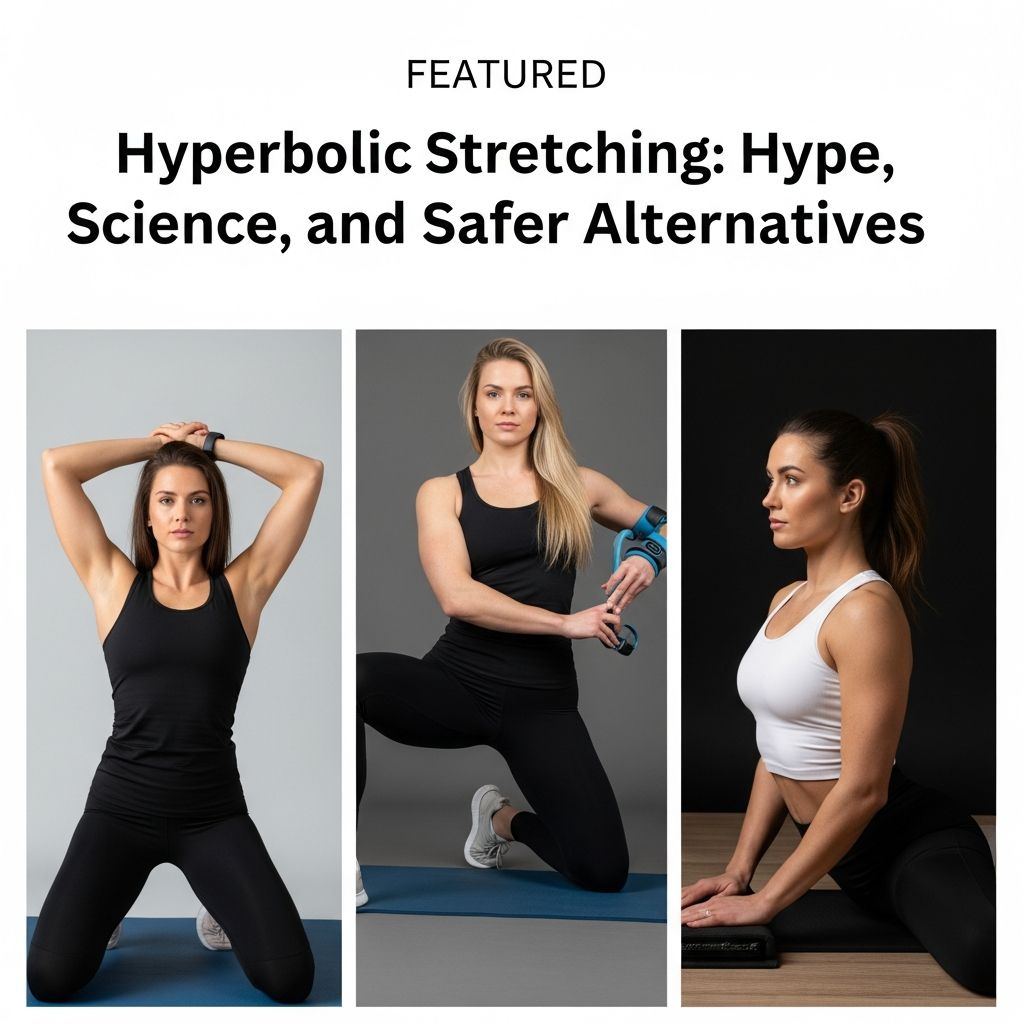
Hyperbolic Stretching: What It Promises vs What Science Supports
Hyperbolic stretching is marketed as a shortcut to extreme flexibility, often promising front splits or dramatic mobility changes in just a few weeks. Behind the catchy branding, though, are familiar stretching methods that have been studied for decades. This article breaks down what hyperbolic stretching is, what research actually says about similar techniques, and how to use stretching safely and realistically.
What Is Hyperbolic Stretching, Really?
Despite the futuristic name, hyperbolic stretching is essentially a structured flexibility program that mixes several known methods:
- Dynamic movements (like controlled leg swings)
- Static holds (traditional stretching positions)
- Isometric contractions (tensing muscles while stretched)
- Breathing and relaxation cues
Many of its ideas resemble Proprioceptive Neuromuscular Facilitation (PNF), particularly the “hold-relax” pattern, where you stretch a muscle, contract it isometrically, then stretch again to a slightly greater range of motion.
Key Components Often Included
- Warm-up patterns – light movements to raise temperature and prepare joints.
- Lower-body flexibility work – hamstring, hip, and groin stretches aimed at splits.
- Core and glute engagement – to stabilize the pelvis during deep positions.
- Breathing techniques – using exhalation to ease tension and deepen stretches.
The marketing focuses on speed and dramatic transformation, but the mechanisms are essentially those of standard, evidence-based flexibility training.
How Flexibility Training Works
To understand what any stretching program can and cannot do, it helps to know what limits flexibility in the first place.
| Factor | What It Means | How Stretching Helps |
|---|---|---|
| Muscle & tendon stiffness | Resistance in soft tissues when lengthened | Regular stretching can increase tolerance to stretch and modestly change stiffness over time. |
| Nervous system response | Reflexes that resist rapid or intense stretch | PNF-style techniques can temporarily allow larger range of motion by altering reflex activity. |
| Joint structure | Shape of bones, capsules, and ligaments | Mostly fixed; stretching cannot radically change joint anatomy in adults. |
| Pain tolerance & perception | How much stretch discomfort you can accept | Gradual practice shifts tolerance, making deeper positions feel acceptable. |
Research on flexibility and PNF stretching shows that improved range of motion is largely a mix of neural adaptation (you “allow” more stretch) and some tissue-level changes, not a sudden transformation of your body’s structure.
What the Evidence Says About Similar Methods
There are no large, independent clinical trials specifically validating branded hyperbolic stretching programs. However, many of the techniques they rely on have been examined under other names.
PNF and Contract–Relax Stretching
PNF stretching, especially the hold-relax method, has strong support for increasing joint range of motion in the short term and over several weeks of training.
- Studies show PNF can improve flexibility and in some cases muscular performance compared with static stretching alone.
- Benefits include increased range in activities like hamstring or hip stretching, which are often targeted in split-focused programs.
Stretching, Pain, and Function
Stretching is frequently used to manage musculoskeletal discomfort. For example, a randomized trial on chronic neck pain found that stretching-based programs can reduce pain intensity and disability when done consistently. That does not mean stretching cures every pain problem, but it supports the idea that a well-designed flexibility routine can be one part of managing stiffness and discomfort.
Injury Prevention and Performance
Guidelines from organizations such as the American College of Sports Medicine (ACSM) recognize flexibility training as part of a complete fitness program.
- Regular stretching is associated with improved range of motion and may reduce injury risk when combined with strength and conditioning.
- For athletes, dynamic stretching before activity can help performance, while long static holds are typically reserved for after training.
Marketing messages claiming a single program can prevent all injuries or dramatically boost performance on its own go beyond what current evidence supports.
Claims vs. Reality: What You Can Expect
Hyperbolic stretching programs often promise results like front splits or major flexibility changes in a fixed time frame. Here is how those claims stack up against what is known from flexibility research.
| Common Claim | What Science Supports | Realistic Expectation |
|---|---|---|
| Achieve full splits in 4–8 weeks | PNF and regular stretching can increase range of motion in weeks, but outcomes vary widely between individuals. | Some people may see large gains, others modest; full splits are not guaranteed and depend on anatomy, age, and consistency. |
| “Unlock” hidden flexibility instantly | Short-term increases after PNF or deep stretching are mostly neural and temporary. | You can gain short-lived range of motion after a session, but lasting change requires weeks to months of practice. |
| Eliminate all pain through stretching | Stretching can reduce some chronic musculoskeletal pain when integrated into broader rehab strategies. | Stretching may help stiffness and some types of pain but is not a cure-all or substitute for medical assessment. |
| Works for everyone, every time | Response to flexibility training varies by genetics, history, joint structure, and training age. | Most people improve at least somewhat, but not everyone will reach extreme positions. |
Potential Benefits of a Well-Designed Stretching Program
Even if the marketing is exaggerated, the core methods used in hyperbolic stretching can offer real benefits when applied sensibly.
- Better flexibility and mobility – Over time, muscles and connective tissues tolerate greater length, making movements like squatting, bending, and reaching easier.
- Improved joint health – Controlled motion through full, comfortable ranges can help reduce stiffness and maintain joint function, especially in people who sit often.
- Enhanced movement quality – More range gives you more options: better technique in sports, smoother daily movements, and fewer compensations.
- Reduced feelings of tightness – Regular stretching may reduce perceived tightness and improve comfort, particularly when combined with strengthening.
- Relaxation and stress relief – Slow stretching with controlled breathing can lower stress and promote a sense of calm, similar to yoga practices.
Risks, Limitations, and Red Flags
Any intense flexibility program brings some risk, especially if your baseline mobility or strength is low. Keep these limitations in mind.
Who Should Be Cautious
- People with joint hypermobility or a history of dislocations.
- Anyone with acute injury (muscle tear, severe sprain) in the target area.
- Individuals with neurological conditions or balance issues that make deep positions unsafe.
- Those with osteoporosis or conditions affecting bone integrity should seek medical guidance first.
Red Flags in Program Marketing
- Promises of “no effort” or “effortless splits.”
- Guarantees that everyone will reach extreme ranges within a set number of days.
- Claims to replace strength training, warm-ups, or medical treatment entirely.
- No mention of contraindications, regressions, or safety guidelines.
Legitimate fitness and rehabilitation guidelines stress gradual progression, individualization, and the importance of combining flexibility with strength and control.
How to Integrate Stretching Safely Into Your Routine
If you want to gain flexibility—whether or not you follow a branded program—using evidence-informed principles is more important than any specific name.
1. Warm Up Before Deep Stretching
- Spend 5–10 minutes with light aerobic work like walking or easy cycling.
- Add gentle dynamic movements that mimic what you plan to stretch (leg swings, arm circles).
Major guidelines recommend warming tissues and joints before intense stretching or strength work.
2. Choose the Right Type of Stretching at the Right Time
- Before workouts: Favor dynamic stretching and shorter holds to prepare for movement without overly dampening power.
- After workouts or separate sessions: Use longer static and PNF-style holds to build range of motion over time.
3. Progress Gradually
- Start with holds of 15–30 seconds and 2–4 repetitions per muscle group.
- Increase total weekly stretching time gradually as comfort and control improve.
- Aim for flexibility work at least 2–3 days per week, which aligns with ACSM recommendations.
4. Pair Flexibility With Strength
Being able to reach a position is only helpful if you can also stabilize it.
- Add strength exercises in the new range, such as split squats, deep goblet squats, or controlled hip hinges.
- Focus on slow, controlled movement rather than bouncing or forcing range.
5. Respect Discomfort Signals
- Stretching should create strong but tolerable tension, not sharp or sudden pain.
- Back off if you feel pinching in a joint, numbness, or burning.
- Seek professional advice if pain persists or worsens.
Sample Evidence-Informed Flexibility Session
This example illustrates how you might structure a safe, progressive routine without relying on marketing promises. Adjust volume and depth to your level.
- Warm-up (5–8 minutes)
- Brisk walking or light cycling
- Dynamic leg swings front-to-back and side-to-side
- Arm circles and torso rotations
- Main stretches (10–15 minutes)
- Hip flexor lunge stretch – 2–3 sets of 20–30 seconds per side
- Hamstring stretch (standing or lying) – 2–3 sets of 20–30 seconds per side
- Adductor (inner thigh) stretch – 2–3 sets of 20–30 seconds
- Optional PNF: gently contract the target muscle for 5–6 seconds, then relax and deepen the stretch for another 10–20 seconds.
- Strength in range (5–10 minutes)
- Bodyweight split squats through a comfortable range
- Slow tempo squats or hip hinges
- Cool-down (2–3 minutes)
- Gentle breathing in comfortable, light stretches
This structure reflects widely used evidence-based guidelines rather than any single commercial program.
Frequently Asked Questions About Hyperbolic Stretching
Q: Is hyperbolic stretching scientifically proven?
A: The branded program itself has not been thoroughly studied in independent clinical trials. However, many techniques it uses—like PNF-style “contract–relax” stretching and dynamic warm-ups—are supported by research showing improvements in flexibility and short-term performance under certain conditions.
Q: How long does it take to see real flexibility improvements?
A: Short-term gains can appear after a single focused session thanks to neural adaptations, but meaningful, lasting changes typically require several weeks to months of consistent practice. Large organizations recommend ongoing flexibility work at least 2–3 days per week as part of a long-term fitness plan.
Q: Can a stretching program alone prevent injuries?
A: Stretching can reduce stiffness and may contribute to lower injury risk when combined with adequate strength, conditioning, and sport-specific preparation. On its own, it is not a guarantee against injury. A balanced program that includes strength training, technique work, and load management is more protective.
Q: Is it safe for beginners to try intense flexibility programs?
A: Beginners should start with simpler, low-intensity stretches and avoid forcing deep ranges. People with previous injuries, hypermobility, or medical conditions should consult a qualified professional before attempting aggressive flexibility routines.
Q: Do I need a branded program to improve flexibility?
A: No. You can make substantial progress with basic dynamic and static stretches, PNF techniques, and simple progression principles. Branded programs can provide structure and motivation, but the underlying methods—not the marketing—drive results.
References
- Garber CE et al. American College of Sports Medicine position stand: quantity and quality of exercise for developing and maintaining cardiorespiratory, musculoskeletal, and neuromotor fitness in apparently healthy adults — Medicine & Science in Sports & Exercise. 2011-07-01. https://doi.org/10.1249/MSS.0b013e318213fefb
- Ylinen J et al. Stretching exercises vs manual therapy in treatment of chronic neck pain: a randomized, controlled cross-over trial — Clinical Rehabilitation. 2007-01-01. https://doi.org/10.1177/0269215506071253
- Hindle KB et al. Proprioceptive Neuromuscular Facilitation (PNF) Stretching: Mechanisms and Clinical Implications — Journal of Human Kinetics. 2012-10-30. https://doi.org/10.2478/v10078-012-0017-7
- Behm DG & Chaouachi A. A review of the acute effects of static and dynamic stretching on performance — European Journal of Applied Physiology. 2011-11-01. https://doi.org/10.1007/s00421-011-1879-2
Similar Articles








Read full bio of Sneha Tete