Infant Cross-Modal Perception: Linking Senses from Birth
Discover how babies from 2-4 months masterfully connect sounds, sights, and touches, building foundational sensory integration skills.
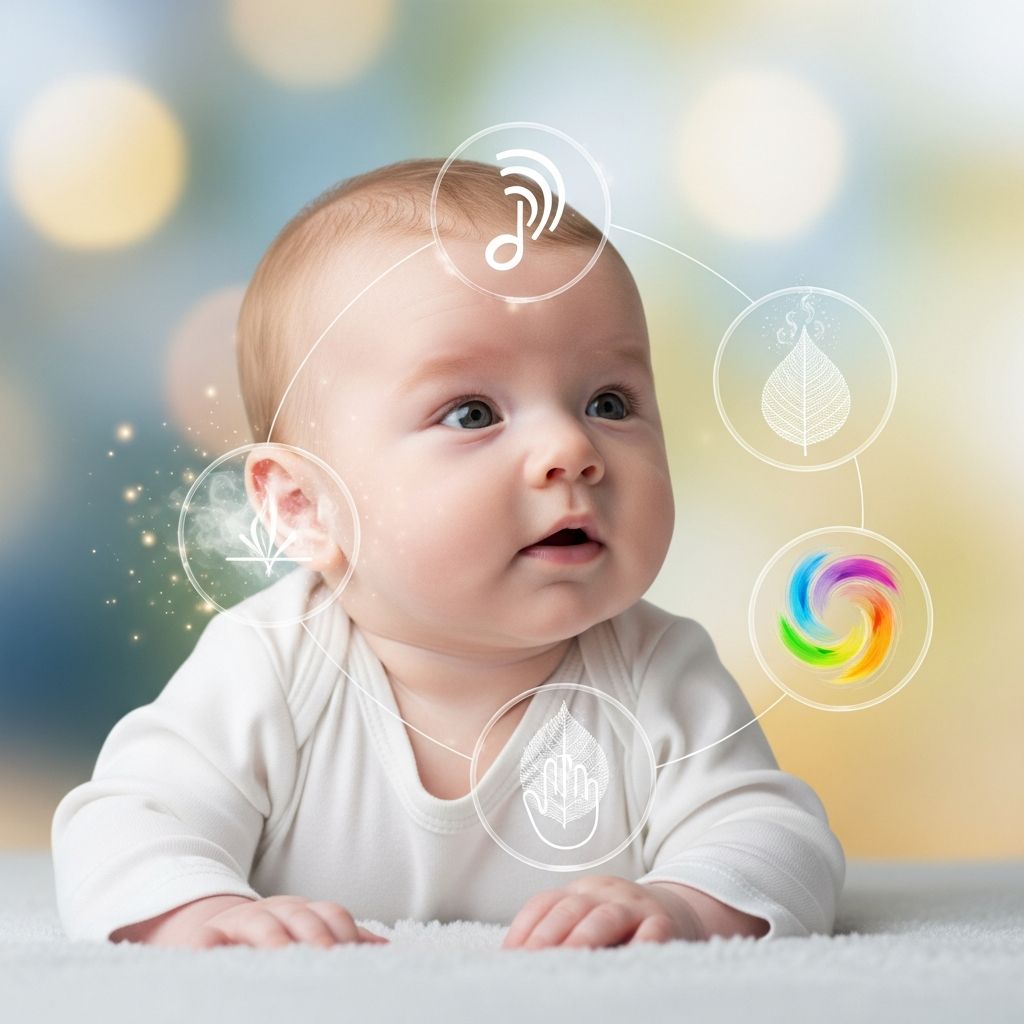
From the moment of birth, infants embark on a journey of sensory discovery, weaving together inputs from hearing, vision, and touch to form a coherent understanding of their world. This process, known as
cross-modal perception
, allows babies as young as 2-4 months to associate auditory cues with visual events, laying the groundwork for advanced cognitive abilities. Research reveals that this integration is not random but guided by innate mechanisms refined through early experiences.The Foundations of Sensory Integration in Newborns
Infants enter the world equipped with rudimentary abilities to detect equivalences across senses. Studies show that even one-month-olds can match tactile experiences to visual representations, such as recognizing the shape of an object felt by mouth when shown images. This intermodal matching demonstrates that sensory systems are interconnected from the earliest stages, challenging older views of separate modality development.
Neuroscientific evidence supports this: newborns exhibit intersensory facilitation, where one sense enhances responsiveness in another. For instance, auditory stimulation can heighten visual attention, directing focus to unified multimodal events. By 2 months, this evolves into precise temporal synchrony detection, where infants link sounds precisely timed with visual actions, like an object striking a surface.
How Babies Connect Sounds to Sights in the 2-4 Month Window
Between 2 and 4 months, a critical sensitive period emerges for cross-modal temporal biases. Infants begin reliably relating auditory signals to visual stimuli based on timing. Research with sight-recovery individuals highlights this: those deprived of pattern vision congenitally but restored early show reversed biases, perceiving visuals as preceding sounds due to adapted neural circuits from atypical early input.
Typically developing babies, however, display a standard bias where vision lags slightly behind audition. This stability arises from myelination differences across sensory areas during infancy, stabilizing individual cross-modal profiles by 1 month. Experiments confirm 2-4 month olds discriminate audio-visual intensity matches, responding to equivalent loudness-brightness pairings much like adults, indicating quantitative cross-modal equivalence.
- Temporal Order Judgment: Babies judge spatio-temporal sequences across modalities, with early experience shaping biases.
- Amodal Properties: Detection of rhythm, tempo, and intensity shared across senses without direct access.
- Neural Adaptation: Exposure to delayed visuals recalibrates perception, evident in cataract reversal studies.
The Role of Sensitive Periods in Shaping Perception
Sensitive periods, particularly the first six months, are pivotal. Congenital cataract patients with vision restored after birth exhibit persistent visual delays relative to sound and touch, unlike those deprived later. This suggests cross-modal temporal ordering solidifies early, with protracted development for spatial elements.
By 3 months, infants detect temporal microstructure in impacts, linking sound waveforms to object rigidity visually. At 4 months, vocal imitation and gesture replication intertwine perception with production, as babies mimic observed facial movements. These milestones underscore how early sensory coordination predicts later language and social skills.
| Age Range | Key Cross-Modal Milestone | Supporting Evidence |
|---|---|---|
| 1 Month | Tactual-visual matching (e.g., pacifier shape) | Infants select felt objects from images. |
| 2-3 Months | Auditory-visual temporal synchrony | Linking sounds to object impacts. |
| 3-4 Months | Intensity equivalence (sound brightness) | Cardiac response generalization. |
| 4 Months | Perception-production link (imitation) | Vocal and gestural mimicry. |
Mechanisms Behind Cross-Modal Matching
Cross-modal perception relies on amodal invariants—properties like duration, rhythm, and intensity perceivable across senses. Infants prioritize these over arbitrary relations initially, capturing attention to unified events. Intersensory redundancy, where multiple senses convey the same info, accelerates differentiation.
Behavioral paradigms like spatio-temporal order judgments reveal biases shaped by experience. Normally sighted infants perceive audition leading vision, but early deprivation flips this, with recalibration persisting post-restoration. This adaptation likely stems from consistent delays, aligning with recalibration models from exposure studies.
Attention dynamics further refine this: cross-modal cues boost orienting, as seen in word mapping where auditory labels enhance visual object binding. By 2-4 months, reduced uncertainty in temporal biases correlates with bias magnitude, highlighting experience-dependent plasticity.
Implications for Long-Term Development
Mastering cross-modal links early fosters object permanence, event understanding, and social cues. Deficits from deprivation impair resolution but not always biases, dissociating processes. This informs interventions: enriched multisensory environments during sensitive windows enhance integration.
Parental interactions—talking while showing toys, syncing touches with voices—amplify natural abilities. Longitudinal data links early intermodal skills to vocabulary growth, emphasizing real-world applications.
Practical Activities to Boost Sensory Integration
- Play peek-a-boo with rattles: Combines visual disappearance with sound cues for temporal linking.
- Mouthable toys with distinct textures and chimes: Encourages tactual-auditory-visual matching.
- Mirrored gestures with songs: Builds perception-production bridges like imitation.
- High-contrast mobiles with synced music: Leverages intensity equivalence.
These activities, grounded in research, harness innate sensitivities without screens, promoting healthy neural wiring.
Frequently Asked Questions (FAQs)
At what age do babies start linking sounds to sights?
Babies show basic audio-visual synchrony by 1-2 months, refining cross-modal temporal order by 2-4 months.
Can early visual deprivation permanently affect sensory integration?
Yes, congenital cases alter biases persistently, though resolution improves; later deprivation has milder effects.
How does cross-modal perception aid language development?
It enables word-object mapping via attention capture, predicting later vocabulary.
Are there signs of poor sensory integration in infants?
Delayed imitation, poor tracking of synced events, or over-reliance on one sense may indicate issues; consult pediatricians.
What role do parents play in fostering these skills?
Interactive play with multisensory toys and responsive caregiving strengthens natural sensitivities.
Challenges and Future Research Directions
While robust, individual variability in myelination influences biases. Future studies could explore tactile-auditory links longitudinally, using non-invasive imaging to track neural changes. Interventions targeting at-risk infants, like preemies, hold promise for mitigating deprivation effects.
In summary, the 2-4 month phase is transformative, with cross-modal perception bridging senses for holistic world-building. Understanding this empowers caregivers to nurture foundational skills effectively.
References
- Sensory experience during early sensitive periods shapes cross-modal temporal biases — eLife Sciences. 2020-10-13. https://elifesciences.org/articles/61238
- Cross-Modal Perception: Can Relate What They Feel with What They See (1-4 Months) — Parenting Counts. Accessed 2026. https://www.parentingcounts.org/cross-modal-perception-can-relate-what-they-feel-with-what-they-see-1-4-months/
- The Development of Infant Intersensory Perception — Lickliter & Bahrick (PDF). 2000. https://infantlab.fiu.edu/publications/publications-by-date/publications-2000-2009/2000_lickliterbahrick_pb_the-development-of-infant-intersensory-perception.pdf
- Cross-Modal Equivalence in Early Infancy: Auditory-Visual Intensity Matching — Lewkowicz (PDF). Accessed 2026. https://home.fau.edu/lewkowic/web/avintensitymatch.pdf
- Towards a developmental cognitive science. The psychophysics of infant perception — PubMed. 1991. https://pubmed.ncbi.nlm.nih.gov/2075949/
- The Dynamics of Infant Attention: Implications for Crossmodal Processing and Word Learning — Wiley Online Library (SRCD). 2016. https://srcd.onlinelibrary.wiley.com/doi/10.1111/cdev.12509
Similar Articles







Read full bio of Sneha Tete