Infant Cross-Modal Perception: Linking Touch and Sight Early On
Discover how babies from 1 to 4 months integrate touch, sight, and sound through cross-modal perception for foundational learning.
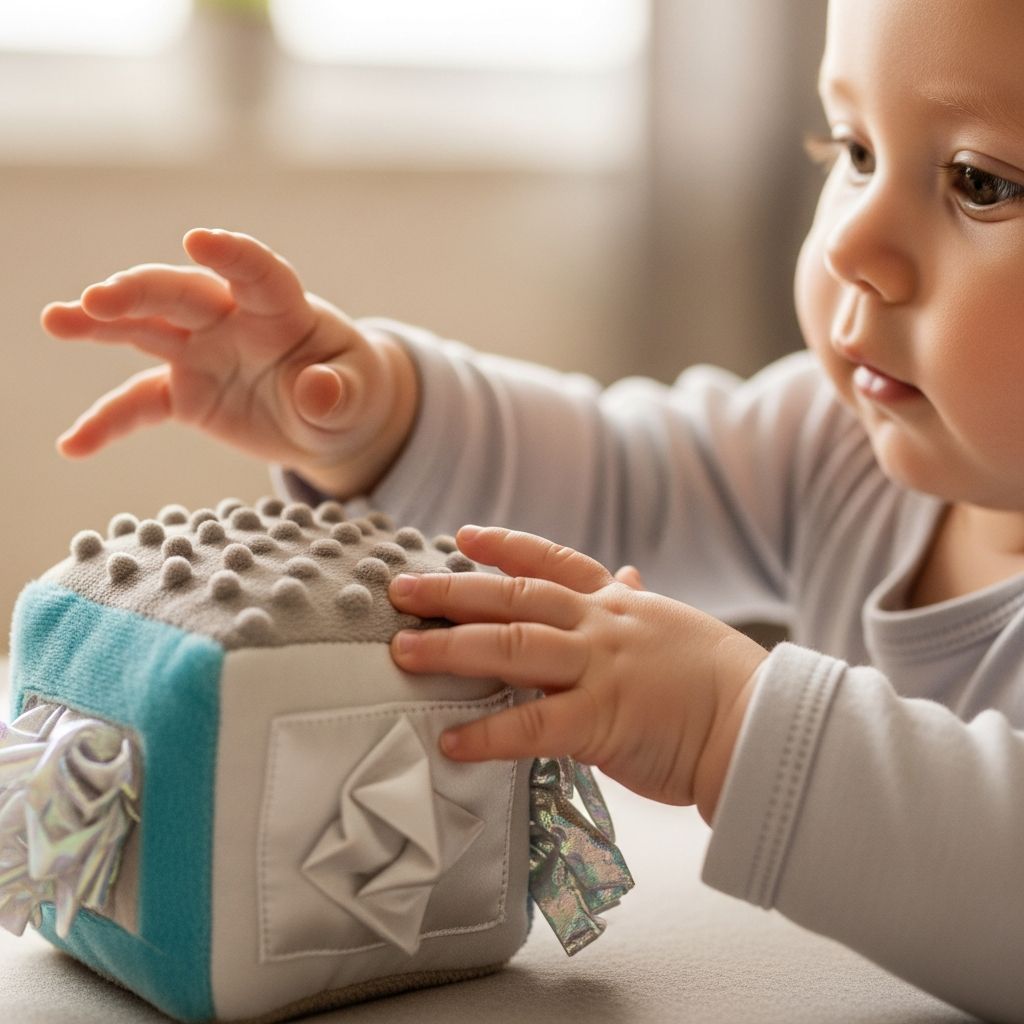
From the moment of birth, babies navigate a world filled with simultaneous sensory inputs—soft textures against their skin, bright colors in their view, and rhythmic sounds in the air. Cross-modal perception enables infants to bridge these experiences, associating what they touch with what they see or hear. This foundational skill emerges remarkably early, between 1 and 4 months, laying the groundwork for advanced cognitive and social development.
Understanding Cross-Modal Perception in Newborns
Cross-modal perception refers to the brain’s capacity to integrate information from different sensory modalities, such as vision, touch, and audition, into a coherent understanding of the environment. In infants, this process is not learned gradually but appears innate, allowing even one-month-olds to match tactile experiences with visual representations.
Research demonstrates that neonates detect equivalences across senses, intertwining perception and action from the earliest days. For instance, newborns mimic facial gestures they observe, showing an immediate link between visual input and motor output. This intersensory coordination helps babies form unified percepts of objects and events, essential for exploring their surroundings.
Early Evidence: Touch-to-Vision Matching at One Month
Studies reveal that as young as one month, infants can discriminate objects based on prior tactile exposure alone. When presented with images after mouthing a pacifier or textured item, they preferentially gaze at matching visuals, indicating intermodal matching. This ability suggests that the infant brain actively compares sensory data, prioritizing amodal properties like shape, texture, and rhythm that transcend single senses.
- Infants select visual depictions of recently sucked pacifiers from distractors.
- They identify hard versus soft objects by sight after oral exploration.
- Such matching relies on detecting invariant features across modalities.
These findings underscore that cross-modal links form rapidly, driven by neural circuits attuned to multisensory redundancy.
The Role of Sensitive Periods in Sensory Calibration
Sensory experience during early sensitive periods profoundly shapes cross-modal biases. Individuals with congenital cataracts reversed in infancy exhibit atypical temporal perceptions, viewing visual events as preceding auditory or tactile ones—opposite to typical development. This reversal stems from adaptation to delayed visual signals during deprivation, highlighting a critical window before six months for establishing standard biases.
In typical infants, slight variations in neural myelination across sensory areas may account for stable individual differences in timing perception, evident from one month. Thus, everyday interactions calibrate the brain’s multisensory timing mechanisms.
Developmental Trajectory: From Amodal to Specific Relations
Infant intersensory perception evolves from detecting broad amodal invariants—properties like synchrony and tempo available across senses—to modality-specific details. Newborns show intersensory facilitation, where one sense boosts another’s responsiveness. By three months, babies link object impacts’ sounds and visuals via temporal microstructure.
| Age | Amodal Detection | Specific Relations |
|---|---|---|
| 1 Month | Temporal synchrony, basic matching | Limited; emerging |
| 3-4 Months | Rhythm, texture equivalences | Improved; arbitrary links guided by amodal cues |
| 7 Months | Advanced composition cues | Strong detection |
This progression reflects differentiation, where attention shifts from global to nested relations, constrained by prior amodal detection.
Mechanisms Behind Multisensory Integration
Neural evidence points to robust intermodal connections at birth, challenging views of initially separate senses integrating via experience. Instead, infants differentiate from unified multisensory processing, with amodal relations capturing attention and facilitating specificity.
Temporal resolution develops protractedly; transient deprivation impairs cross-modal ordering, dissociable from bias formation. Uncertainty in one modality correlates with larger biases, emphasizing experience’s tuning role.
Implications for Cognitive and Social Growth
Cross-modal skills underpin word mapping and attention dynamics, linking early perception to language. By associating object properties across senses, infants build object permanence and event understanding, crucial for learning.
Parental interactions amplify this: handling toys while naming them provides synchronized cues, strengthening links. Delays in integration may signal developmental risks, warranting early screening.
Practical Activities to Boost Sensory Integration
Engage 1-4 month olds in multisensory play:
- Texture Exploration: Let baby mouth varied safe objects, then show photos for matching.
- Synch Play: Clap hands while watching rhythmic lights.
- Skin-to-Sight: Stroke with fabrics, pair with visual patterns.
These foster natural calibration, enhancing neural pathways.
Frequently Asked Questions (FAQs)
What is cross-modal perception in babies?
It’s the ability to connect information from different senses, like matching a felt texture to its visual appearance.
At what age does it start?
Evidence shows capabilities from one month, with newborns demonstrating basic equivalences.
How does sensory deprivation affect it?
Congenital visual loss alters temporal biases if unresolved before sensitive periods end around 6 months.
Why is it important for development?
It builds unified world models, aiding attention, learning, and social skills.
Can parents support it?
Yes, through multisensory toys and interactive play providing concurrent cues.
Long-Term Outcomes and Research Frontiers
Early cross-modal proficiency predicts later perceptual acuity. Ongoing studies explore how these biases influence language acquisition and autism spectrum traits, where multisensory issues prevail. Future work may target interventions for at-risk infants.
In summary, the 1-4 month window cements sensory bridges, transforming raw inputs into meaningful experiences. Nurturing this phase unlocks boundless developmental potential.
References
- Sensory experience during early sensitive periods shapes cross-modal temporal biases — eLife Sciences. 2020-08-07. https://elifesciences.org/articles/61238
- Cross-Modal Perception: Can Relate What They Feel with What They See (1-4 Months) — Parenting Counts. Accessed 2026. https://www.parentingcounts.org/cross-modal-perception-can-relate-what-they-feel-with-what-they-see-1-4-months/
- The Development of Infant Intersensory Perception — Lickliter & Bahrick, Infant Behavior and Development. 2000. https://infantlab.fiu.edu/publications/publications-by-date/publications-2000-2009/2000_lickliterbahrick_pb_the-development-of-infant-intersensory-perception.pdf
- Towards a developmental cognitive science. The psychophysics of infant perception — PubMed (Child Development). 1991. https://pubmed.ncbi.nlm.nih.gov/2075949/
- The Dynamics of Infant Attention: Implications for Crossmodal Processing and Word Learning — SRCD Child Development. 2016. https://srcd.onlinelibrary.wiley.com/doi/10.1111/cdev.12509
Similar Articles








Read full bio of Sneha Tete