Newborn Vision: High-Contrast Fascination (0-2 Months)
Discover how newborns' eyes lock onto bold contrasts and edges in their first weeks, fueling vital visual growth and engagement.
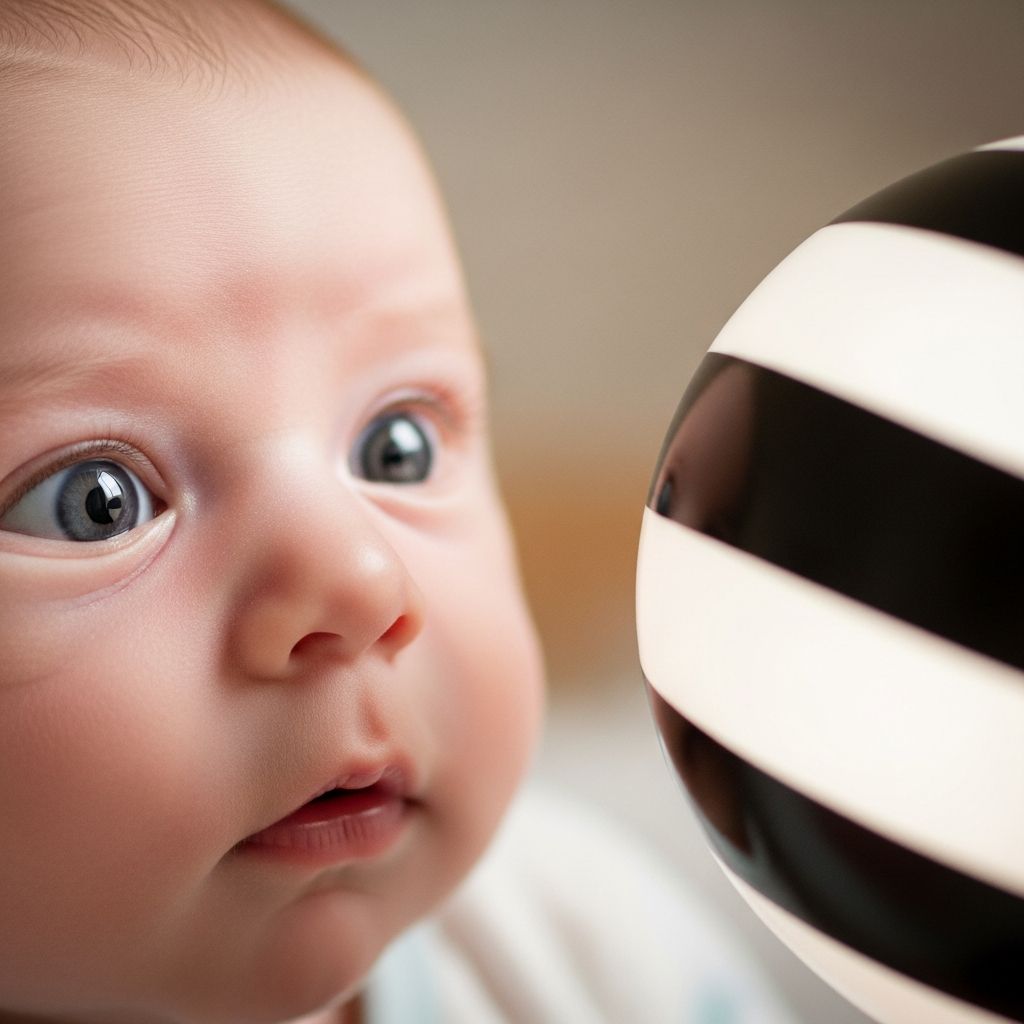
Newborns possess remarkably limited yet purposeful vision at birth, with a strong preference for high-contrast patterns and sharp edges that capture their attention and drive early visual maturation.
Understanding the Foundations of Infant Eyesight
From the moment of birth, a baby’s visual system is operational but immature. Infants enter the world nearsighted, focusing best at distances of 8 to 12 inches, roughly the span from their eyes to a caregiver’s face during feeding. This proximity allows them to discern faces, light, basic shapes, and movement, but finer details like pastels or subtle gradients remain blurred.
High-contrast elements—think bold black-and-white stripes, checkerboards, or defined outlines—stand out prominently in this grayscale-dominant world. Research demonstrates that newborns actively turn their heads toward these patterns, ignoring uniform or low-contrast visuals. This innate attraction stems from the retinal cells’ heightened sensitivity to edges and luminance differences, aiding the brain in mapping the environment.
Why High Contrast Captivates Newborns
The human visual cortex prioritizes detecting boundaries and changes in brightness, a survival mechanism refined over evolution. For newborns, whose eyes are about 65% of adult size and lack full coordination, these stark visuals provide maximal stimulation without overwhelming their system.
- Edge Detection: Babies’ retinas excel at spotting borders, turning toward outlines over smooth areas.
- Pattern Preference: Experiments confirm infants favor complex high-contrast designs like bull’s-eyes or spirals.
- Grayscale Focus: Color vision emerges slowly; initial sight is black, white, and gray shades.
By 2 months, this preference evolves as eyes align better, enabling smoother tracking and faint color hints. Such selectivity isn’t random—it’s the brain’s way of practicing focus and fixation.
Key Milestones in the First Eight Weeks
| Age Range | Visual Abilities | Preferred Stimuli |
|---|---|---|
| Birth to 1 Month | Sees 8-12 inches; detects light, motion, faces; eyes may wander | High-contrast faces, bold patterns, edges |
| 1-2 Months | Begins tracking slow-moving objects; recognizes familiar faces; occasional eye fixation | Black-white designs, polka dots, caregiver smiles |
| By 2-3 Months | Follows across midline; starts reaching; improved coordination | Moving contrasts, simple shapes |
These stages build progressively: initial reflexes give way to voluntary gaze shifts. At 6 weeks, focus extends to 12 inches, with tracking emerging.
Practical Activities to Boost Visual Growth
Parents can harness this fascination with everyday items. Position high-contrast mobiles above the crib or create DIY cards with sharp patterns. Hold black-and-white images 8-10 inches from baby’s face, slowly moving them side-to-side to encourage tracking.
- Safe crib mirrors at eye level for self-discovery.
- Bright red-and-black toys (red is among first colors perceived).
- Gentle face gazing during interactions, mimicking smiles.
- Contrast mobiles or wall hangings, rotated regularly for novelty.
Avoid soft pastels initially, as they blend into the newborn’s blurry vista. These interactions not only entertain but strengthen eye muscles and neural pathways.
Recognizing Normal vs. Concerning Signs
Occasional eye wandering or crossing is typical in the first two months, as muscles mature. By 3 months, consistent tracking and alignment should prevail. Persistent issues—like one eye always turning in/out, no fixation, or lack of response to faces—warrant pediatric consultation.
Early screening ensures timely intervention, preventing long-term challenges like amblyopia. Track milestones: Does your baby follow a rattle? Smile at your face? These affirm healthy progress.
Science Behind Contrast-Driven Development
Neuroscientific studies reveal newborns’ visual preference activates the occipital lobe efficiently. High-contrast stimuli elicit stronger pupillary responses and longer gazes, correlating with faster acuity gains. This phase lays groundwork for depth perception (around 5 months) and full color vision (4-5 months).
Binocular vision refines by 2-4 months, allowing 3D perception as eyes converge. Parental engagement amplifies these gains, fostering hand-eye coordination precursors.
Long-Term Impact of Early Visual Stimulation
Robust 0-2 month vision sets the stage for crawling (enhancing depth via 9-12 months exploration), object recognition (by 12 months), and fine motor skills (1-2 years). Children with stimulated early vision show advanced spatial awareness and learning readiness. Outdoor play later builds distance vision, while textured toys refine close focus.
By 2 years, vision nears adult sharpness, supporting drawing and play. Consistent nurturing yields confident explorers.
Frequently Asked Questions (FAQs)
Why do newborns stare at high-contrast patterns?
Newborns’ immature retinas detect edges and brightness shifts best, making bold patterns easiest to process and most engaging.
At what distance can my newborn see clearly?
Typically 8-12 inches, ideal for faces during bonding.
When should my baby’s eyes stop crossing?
By 2-3 months; consult a doctor if persistent.
Are colorful toys useless for newborns?
Partially—prioritize black-white first; colors develop later.
How can I tell if my baby’s vision is developing normally?
Look for tracking by 2 months, face recognition, and reaching; pediatric checks confirm.
Expert Tips for Everyday Integration
Incorporate visuals into routines: pattern nursing pillows, striped swaddles, or app-generated contrasts. Limit screen time; prioritize real-world interaction. Consult resources from trusted pediatric organizations for tailored advice.
This period’s stimuli build lifelong visual prowess, turning tiny gazes into world-conquering sights.
References
- Vision Development Timeline: A Guide for New Mothers — Insight Vision OC. 2023. https://www.insightvisionoc.com/vision-therapy/vision-development-timeline-a-guide-for-new-mothers/
- Infant Vision Birth to One Year — Nationwide Children’s Hospital. 2024-10-15. https://www.nationwidechildrens.org/family-resources-education/health-wellness-and-safety-resources/helping-hands/infant-vision-birth-to-one-year
- Infant Vision Development: What Can Babies See? — American Academy of Pediatrics (healthychildren.org). 2025-01-20. https://www.healthychildren.org/English/ages-stages/baby/Pages/Babys-Vision-Development.aspx
- Infant development: Birth to 3 months — Mayo Clinic. 2024-11-05. https://www.mayoclinic.org/healthy-lifestyle/infant-and-toddler-health/in-depth/infant-development/art-20048012
- Your Baby’s Hearing, Vision, and Other Senses: 2 Months — KidsHealth (Nemours). 2024. https://kidshealth.org/en/parents/senses-2mos.html
- Your Baby’s Vision — ZERO TO THREE. 2023-08-10. https://www.zerotothree.org/resource/your-babys-vision/
- Parents’ Guide to Baby’s Vision Development — Pathways.org. 2024. https://pathways.org/videos/parents-guide-babys-vision-development
Similar Articles





Read full bio of Sneha Tete