Understanding Theory of Mind in 4-5 Year Olds
Discover how children aged 48-57 months grasp that others hold different, sometimes inaccurate, views of reality.
Between 48 and 57 months, children typically begin grasping that other people can hold beliefs about the world that differ from reality or their own knowledge. This milestone, known as theory of mind, marks a pivotal shift in social cognition, enabling preschoolers to navigate complex interactions with greater empathy and foresight.
The Foundations of Perspective-Taking
Theory of mind refers to the ability to attribute mental states—such as beliefs, desires, and intentions—to oneself and others, understanding these states may not align with actual events. For 4-to-5-year-olds, a core realization is that peers or adults might perceive situations inaccurately, leading to behaviors based on false premises.
This development builds on earlier skills like recognizing emotions and basic empathy. Preschoolers start predicting actions based not just on facts, but on what someone thinks is true, fostering deeper social bonds and conflict resolution. Research shows this emerges around age 4, distinguishing children who succeed in social settings from those who struggle.
Key Milestones in Social Cognition
- Recognizing Diverse Beliefs: Children understand a friend might believe a toy is hidden in one spot while it’s actually elsewhere.
- Predicting Behavior from Beliefs: They anticipate actions based on mistaken perceptions, like searching in the wrong location.
- Understanding Deception: Grasping that people can intentionally mislead others about reality.
- Empathy Through Insight: Appreciating why someone feels upset due to their unique viewpoint.
These milestones correlate with improved peer interactions, reduced aggression, and better emotional regulation, as children learn to cooperate and share more effectively.
Why This Skill Matters for Preschool Success
Mastering theory of mind equips children for preschool’s social demands. It underpins forming friendships, resolving disputes without tantrums, and thriving in group play. Kids with strong perspective-taking skills enjoy more positive relationships, face less bullying, and achieve higher academically due to supportive environments.
Without it, preschoolers may insist on their version of truth, leading to frustration or isolation. Conversely, those who ‘get it’ navigate pretend play, turn-taking, and rules with ease, building self-esteem and resilience. Long-term, this foundation predicts success in school and adulthood social dynamics.
Signs Your Child is Developing Theory of Mind
| Age Range | Observable Behaviors | Examples |
|---|---|---|
| 48-50 months | Basic false belief recognition | Understands a sibling might think the light is on when it’s off if they haven’t seen it switched. |
| 51-54 months | Predicts actions from beliefs | Expects a peer to look for a misplaced snack in the last seen spot. |
| 55-57 months | Handles complex scenarios | Realizes a trick or lie changes someone’s perception intentionally. |
These indicators show progress; variations are normal, influenced by language skills and social exposure.
Everyday Activities to Nurture This Growth
Parents and educators can spark theory of mind through playful, low-pressure interactions. Integrate these into routines for natural reinforcement.
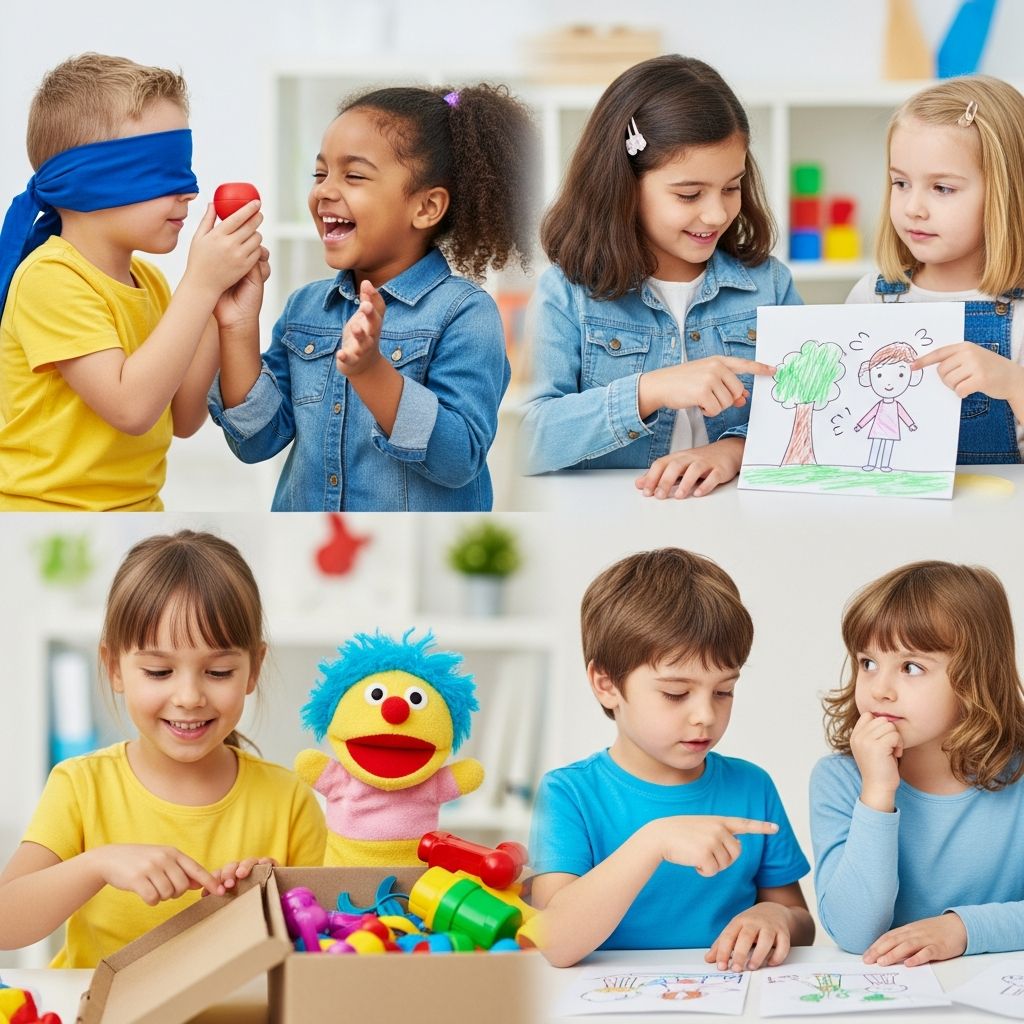
- Storytime Discussions: After reading, ask, “What does the character think is happening?” to highlight mismatched beliefs.
- Hide-and-Seek Variants: Hide an object and mislead a playmate about its location, then discuss their search logic.
- Puppet Shows: Use puppets with conflicting info—one sees a ball under a cup, another doesn’t—to act out surprises.
- Role-Play Games: Pretend to be characters with different knowledge, like one ‘forgetting’ a change in plans.
- Emotion Charades: Act out feelings based on imagined scenarios, prompting guesses about ‘why’ they feel that way.
These activities boost not just theory of mind but cooperation, listening, and empathy, key for preschool social flourishing.
The Role of Adults in Modeling Social Insight
Children learn by observing responsive caregivers who verbalize perspectives: “Your friend thinks the toy is broken because he didn’t see you fix it.” This scaffolding helps internalize the concept. Positive relationships provide safe spaces for practice, validating emotions and encouraging expression.
Avoid correcting harshly; instead, guide: “Maybe she believes that because…” Consistent modeling yields preschoolers who self-regulate, share, and empathize independently.
Challenges and How to Overcome Them
Not all children hit milestones simultaneously. Language delays, limited peer exposure, or family stress can slow progress. Signs of lag include persistent egocentrism—insisting ‘I know best’—or difficulty in group play.
Strategies include more one-on-one playdates, emotion-focused books, and professional input if concerns persist. Early intervention ensures catch-up, as social skills snowball[10].
Long-Term Benefits for Emotional Health
By kindergarten, strong theory of mind links to advanced self-awareness, conflict resolution, and leadership. It fosters resilience against setbacks, as children reframe events through others’ eyes. Ultimately, it cultivates compassionate adults capable of nuanced relationships.
Frequently Asked Questions (FAQs)
What is theory of mind in simple terms?
The understanding that others have thoughts, feelings, and beliefs different from your own and possibly wrong about facts.
At what exact age do most children develop false belief understanding?
Around 48 months, though full mastery varies up to 57 months and beyond, per developmental studies.
How can I tell if my child lacks this skill?
They may fail simple tests like expecting everyone knows what they know or struggle predicting peers’ mistaken actions.
Are activities essential, or does it develop naturally?
Interaction accelerates it; guided play provides necessary practice in real social contexts.
Does screen time affect this development?
Excessive passive viewing may limit peer practice; opt for interactive, social-content media sparingly.
Building a Supportive Environment at Home and Preschool
Create spaces rich in social cues: group games, diverse playmates, and reflective talks. Preschools emphasizing cooperative play amplify growth. Track progress through journals, celebrating small wins to boost confidence.
Parental involvement—modeling patience, discussing viewpoints—yields the best outcomes. Collaborate with educators for consistent reinforcement across settings[10].
References
- A Complete Guide to Social Skills Development for Preschoolers — Brightwheel. 2023. https://mybrightwheel.com/blog/social-skills-development-in-preschool
- Social-Emotional Development: Preschool Children — Virtual Lab School. 2023. https://www.virtuallabschool.org/preschool/social-and-emotional-development/lesson-2
- Social Development in Early Childhood — United Nations International School of Hanoi. 2023. https://www.unishanoi.org/about/calendar-news-and-publications/post-default/~board/news/post/social-development-in-early-childhood
- Understanding Social and Emotional Development in Preschoolers — Kids ‘R’ Kids South Woodlands. 2021-04-07. https://kidsrkids.com/south-woodlands/2021/04/07/understanding-social-and-emotional-development-in-young-children/
- Understanding and Supporting Social-Emotional Development in Young Children — Little Scholars NYC. 2023. https://littlescholarsnyc.com/understanding-and-supporting-social-emotional-development-in-young-children/
- 8 Tips to Foster Social-Emotional Development in Preschoolers — Bright Horizons. 2023. https://www.brighthorizons.com/article/children/social-emotional-development-in-preschoolers
- Social Development in Preschoolers — American Academy of Pediatrics (healthychildren.org). 2023. https://www.healthychildren.org/English/ages-stages/preschool/Pages/Social-Development-in-Preschoolers.aspx
Similar Articles






Read full bio of Sneha Tete